Polk Signa S4 or TCL Q85H? Which is better for Atmos?

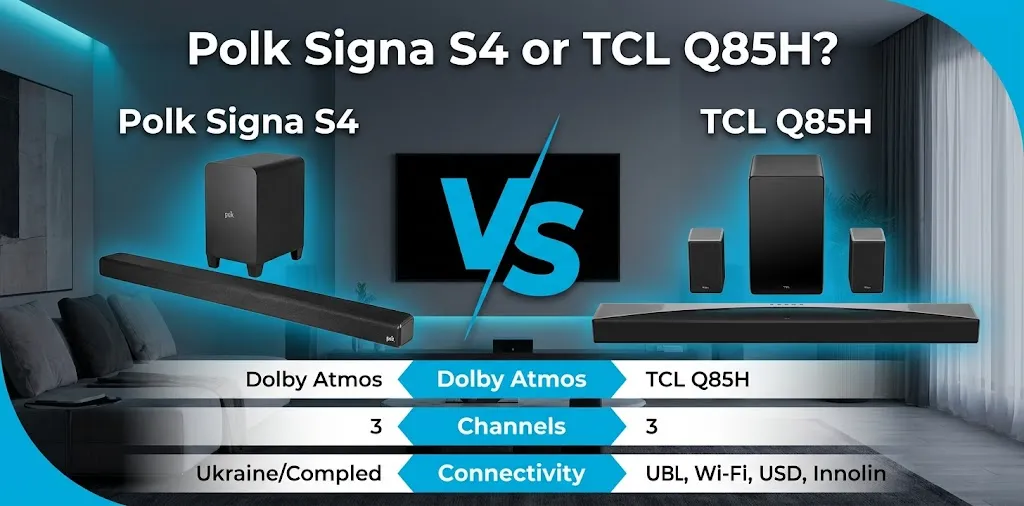
If Dolby Atmos is your main reason for buying a soundbar, the TCL Q85H is the better choice. Its 7.1.4 setup includes wireless rear speakers with up-firing drivers, while the Polk Signa S4 is a simpler 3.1.2 system with two up-firing height drivers. The TCL creates a more complete sense of sound coming from above, behind, and around you.
The Polk Signa S4 is still worth considering if you want a simpler and less expensive Atmos setup. It includes a wireless subwoofer, dedicated height drivers, and Polk’s VoiceAdjust feature for dialogue. But when the question is specifically Polk Signa S4 or TCL Q85H for Atmos, the extra channels and rear height speakers give the TCL a clear advantage.
Polk Signa S4 vs TCL Q85H: At a Glance
| Feature | Polk Signa S4 | TCL Q85H |
|---|---|---|
| Channel configuration | 3.1.2 | 7.1.4 |
| Dolby Atmos | Yes | Yes |
| DTS:X | Not listed by Polk | Yes |
| Up-firing speakers | 2 in soundbar | Soundbar + rear speakers |
| Wireless subwoofer | Yes | Yes |
| Wireless rear speakers | No | Yes |
| Rear up-firing speakers | No | Yes |
| Room calibration | No | AI Sonic |
| HDMI | 1 eARC connection | HDMI eARC + HDMI input |
| AirPlay 2 | No | Yes |
| Bluetooth | Yes | Yes |
| Main strength | Simple Atmos setup and dialogue | More immersive surround and Atmos |
| Current manufacturer price checked | $359 | $599.99 sale price |
| Available |  | |
Polk lists the Signa S4 as a 3.1.2 Dolby Atmos system with a wireless subwoofer and two dedicated elevation drivers. TCL’s Q85H is a 7.1.4 system with wireless surround speakers, up-firing drivers, a wireless subwoofer, and room calibration.
The current TCL price shown by TCL is $599.99, reduced from $899.99. Polk’s U.S. site currently lists the Signa S4 at $359.
Why the TCL Q85H Is Better for Atmos
The biggest difference is not simply that both soundbars support Dolby Atmos. Atmos support alone does not tell you how convincing the experience will be. The speaker layout matters.
The Signa S4 uses a 3.1.2 layout. The “.2” represents its two height channels, which are produced by the up-firing drivers in the soundbar. Those drivers bounce sound off the ceiling to create the impression that some effects are coming from above.
The Q85H goes much further with a 7.1.4 configuration. It has up-firing speakers in the main bar and wireless surround speakers that also have up-firing drivers. This gives the system more physical speaker locations for reproducing Atmos effects around and above the listener.
That difference becomes especially noticeable with movies that use a lot of overhead and rear-channel effects. Instead of keeping most of the sound in front of you, the TCL has dedicated rear speakers that can place effects behind your seating position.
The rear speakers make the biggest difference
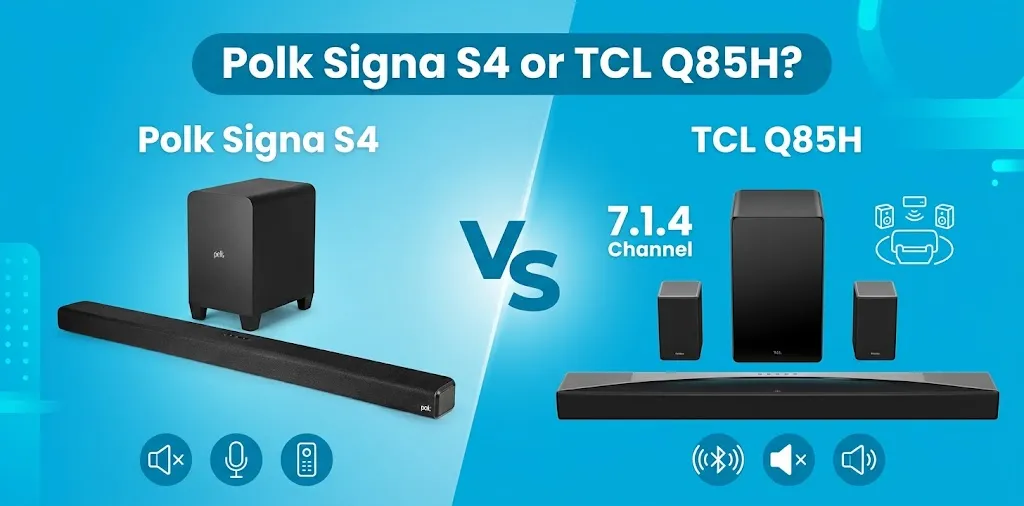
This is the most important reason to choose the TCL. The Signa S4 does not include dedicated rear speakers. Reviews of the Polk have found its soundstage wide and its Atmos effects impressive for its class, but it cannot create the same physical rear-channel separation as a system with actual surround speakers.
The Q85H includes wireless surround speakers, and those speakers have their own up-firing drivers. TCL specifically describes them as having forward- and up-firing speakers.
So if a movie has an aircraft moving overhead and then an effect continuing behind you, the Q85H has a better physical speaker arrangement for reproducing that movement.
Dolby Atmos Sound Quality
The Polk Signa S4 does a good job considering its simpler design. Its two elevation drivers can create a noticeable sense of height, and independent reviews have praised its Atmos performance. Digital Trends, for example, found its up-firing drivers capable of producing convincing overhead effects in Atmos movies.
However, the ceiling-reflection approach has limits. Your room affects how well those effects work. Ceiling height, shape, and the position of the soundbar and seating can all influence the result.
The TCL has the same basic limitation with its up-firing speakers, but it adds rear speakers and additional height channels. That gives it more information to work with and creates a more enveloping presentation.
RTINGS found the Q85H to be very good for movies, noting that its side-firing drivers widen the soundstage while its up-firing drivers add height for Dolby Atmos content.
For someone buying specifically for Atmos movies, the Q85H has the stronger hardware setup.
Polk Signa S4 Is Better for a Simple Setup
The Polk has a major advantage: simplicity. You get the soundbar, wireless subwoofer, remote, and the cables needed to connect it. Polk provides HDMI eARC, optical, and 3.5mm analog connectivity, along with Bluetooth.
There are no rear speakers that need to be placed behind your couch. That can matter if your living room is small, your sofa is against a wall, or you simply don’t want extra speakers around the room.
Polk also includes VoiceAdjust technology, which lets you increase dialogue clarity without simply turning up the entire soundtrack. For everyday TV watching, that can be more useful than having a larger number of channels.
TCL Q85H Has More Home Theater Features
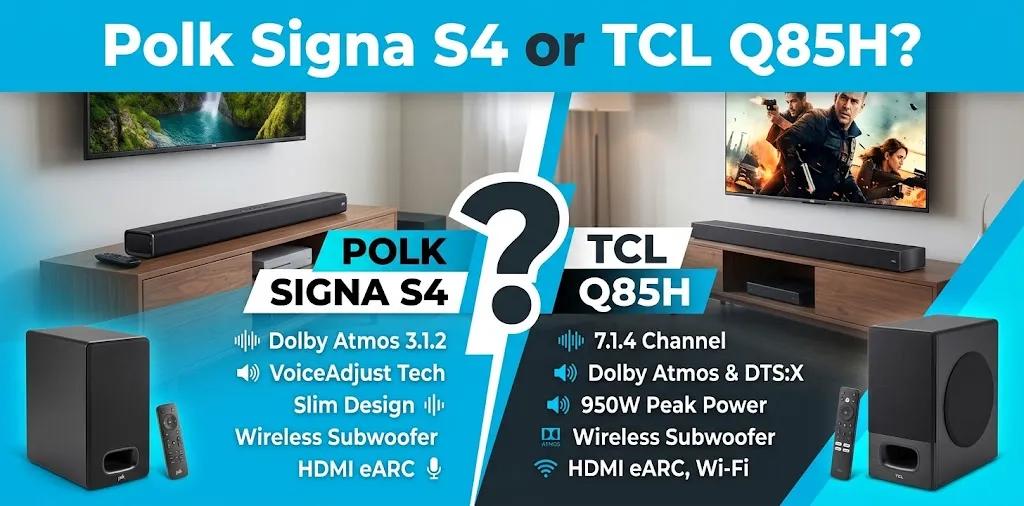
The Q85H is built more like a complete home theater package. It supports Dolby Atmos and DTS:X, includes HDMI eARC and a separate HDMI input, and offers features such as AirPlay 2, Bluetooth, USB audio playback, and the TCL Home app. It also includes AI Sonic room calibration.
The HDMI input is particularly useful if you have an external streaming device, game console, or other source that you want to connect directly to the soundbar.
The TCL also supports 4K HDR-related passthrough features, including Dolby Vision, according to TCL’s product information.
The Polk is much more limited. It has one HDMI eARC connection, optical, analog input, Bluetooth, and USB for firmware updates.
Which One Has Better Bass?
Both packages include a wireless subwoofer, so neither is dependent on the soundbar alone for low frequencies.
The Signa S4 uses a 5.9-inch subwoofer driver. Polk describes the wireless subwoofer as providing deep bass and says it is designed to blend with the soundbar.
The Q85H has a larger 6.5-inch wireless subwoofer and includes Bass Boost. TCL also rates the complete system for up to 860 watts of total power, although the company separately lists 620 watts in its feature section, so the power figures should not be treated as a direct measure of sound quality.
In practical terms, the TCL has the more substantial overall system, but that does not automatically mean its bass will sound better in every room. Subwoofer placement and room acoustics still matter.
Which One Is Better for Movies?
The reason is immersion rather than simply volume. A good Atmos movie can contain sounds positioned above, beside, in front of, and behind the listener. The Q85H’s rear speakers give those effects a physical source behind the seating position, while the rear up-firing drivers add another height layer.
The Signa S4 can still make movies sound dramatically better than most TV speakers. Its dedicated center channel helps dialogue, while the two height drivers add an overhead dimension. Independent testing has also found its Atmos effects impressive for a relatively simple system.
But if your priority is getting closer to a real surround setup without buying a separate AV receiver and speaker package, the TCL makes more sense.
What About a Small Living Room?
This is where the Polk becomes more attractive. Imagine a small apartment living room where the couch sits close to the back wall. Running rear speakers may be inconvenient, and there may not be much space to position them correctly.
In that situation, the Signa S4 gives you a clean setup with a subwoofer and built-in height channels. You still get Dolby Atmos without filling the room with additional speakers.
For a larger living room where the sofa has space in front of the rear wall, the Q85H’s wireless surrounds become much more useful.
The room itself also matters for up-firing Atmos. If your ceiling does not provide suitable reflections, neither system will reproduce overhead effects as effectively as a system using physical ceiling speakers.
Which One Is the Better Value?
The answer depends on what you mean by value. At the prices currently shown on the manufacturers’ U.S. sites, the Polk Signa S4 is considerably less expensive than the TCL Q85H. Polk lists the S4 at $359, while TCL lists the Q85H at $599.99 during its current promotion.
So the Polk is the better choice if you want basic Dolby Atmos at a lower cost.
The TCL is the better value if you specifically want a more complete Atmos system with rear surrounds, additional height channels, room calibration, and more connectivity. You are paying more, but you’re also getting substantially more hardware.
Polk Signa S4 or TCL Q85H for Different Buyers
| If you are… | Better choice | Why |
|---|---|---|
| Mainly watching Atmos movies | TCL Q85H | More channels and rear height speakers |
| Living in a small room | Polk Signa S4 | Simpler setup with fewer speakers |
| Looking for the lowest price | Polk Signa S4 | Lower current manufacturer price |
| Wanting rear surround effects | TCL Q85H | Includes wireless surround speakers |
| Wanting clearer dialogue controls | Polk Signa S4 | VoiceAdjust is a useful dedicated feature |
| Using multiple HDMI devices | TCL Q85H | Includes HDMI input in addition to eARC |
| Wanting room calibration | TCL Q85H | Includes AI Sonic calibration |
| Wanting the strongest Atmos setup | TCL Q85H | 7.1.4 versus 3.1.2 |
Two Real-World Buying Scenarios
A buyer with a 55-inch TV in a small apartment may prefer the Polk Signa S4. They can place the bar below the TV, put the subwoofer on the floor, connect HDMI, and get Atmos height effects without finding locations for rear speakers.
A buyer with a 65-inch or larger TV, a dedicated sofa area, and enough space behind the seating position should look harder at the TCL Q85H. Its wireless rear speakers can create a much more convincing surround field, while their up-firing drivers add another layer to Atmos playback.
The One Important Atmos Limitation
Neither soundbar should be mistaken for a full ceiling-speaker Atmos system. Both rely partly on reflected sound from up-firing drivers. That means your room can have a major effect on the height effect. The Polk has two height drivers in the bar, while the TCL adds up-firing drivers to its rear speakers, but neither can guarantee the same precise overhead positioning as dedicated speakers installed above the listening position.
That is why the TCL’s advantage should be understood as better soundbar-based Atmos immersion, not perfect cinema-style Atmos.
Frequently Asked Questions
Still deciding between the Polk Signa S4 and TCL Q85H? These common questions can help you compare their Dolby Atmos performance, surround sound setup, room requirements, and overall value before choosing the right soundbar for your home theater.
Is the TCL Q85H better than the Polk Signa S4 for Dolby Atmos?
Yes. The TCL Q85H has a 7.1.4 configuration with wireless surround speakers and additional up-firing drivers, while the Polk Signa S4 uses a 3.1.2 layout with two up-firing drivers. The TCL therefore has a more complete setup for Atmos effects around, behind, and above the listener.
Does the Polk Signa S4 have real Dolby Atmos?
Yes. The Signa S4 supports Dolby Atmos and has two dedicated up-firing elevation drivers designed to create height effects. It is a true Atmos-capable soundbar system, although its 3.1.2 layout is less immersive than the TCL Q85H’s 7.1.4 configuration.
Is the TCL Q85H worth paying more for?
For Atmos-focused home theater use, the extra cost can be justified because you are getting wireless rear speakers, additional height channels, room calibration, and more connectivity. If you have a small room or don’t want rear speakers, the less expensive Polk Signa S4 may be the more practical choice.
Final Verdict
If the question is simply “Polk Signa S4 or TCL Q85H: Which is better for Atmos?”, my pick is the TCL Q85H.
The Polk Signa S4 is a good choice when you want affordable Dolby Atmos, strong dialogue clarity, a wireless subwoofer, and a simple 3.1.2 setup. It makes sense for smaller rooms and buyers who don’t want rear speakers.
But the TCL Q85H is in a different class for immersive surround. Its 7.1.4 configuration, wireless rear speakers, rear up-firing drivers, room calibration, and broader connectivity give it the more convincing Atmos setup.