Sony HT-S2000 or Bose Smart Soundbar? Which is better for small rooms?

For a small room, the Bose Smart Soundbar is the better overall choice if you want a compact design, Dolby Atmos with dedicated upward-firing speakers, strong dialogue features, and Wi-Fi streaming. The Sony HT-S2000 is the better value if you care more about built-in bass, DTS:X support, a dedicated 3.1-channel layout, and a simpler TV-focused setup.
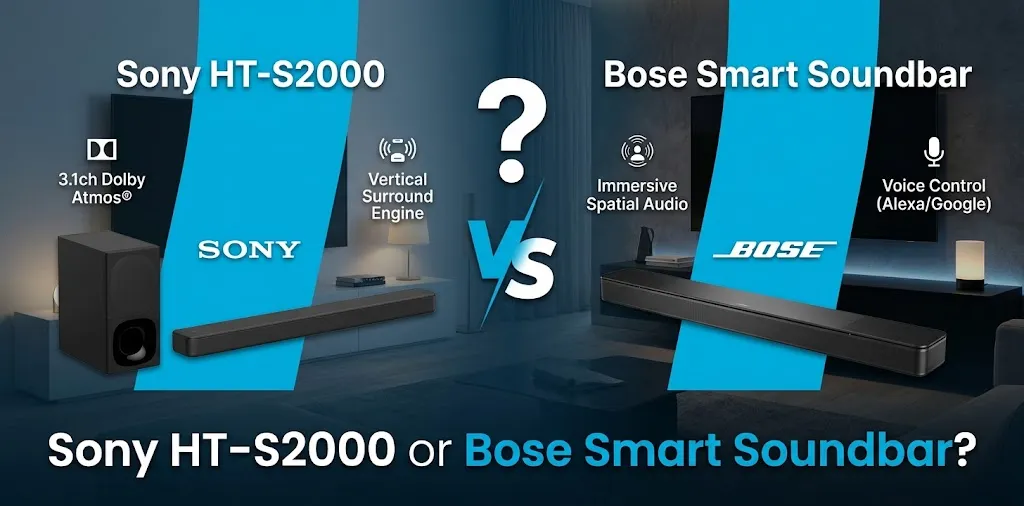
The two soundbars are close in size, but they take different approaches to improving TV audio. Sony focuses on a 3.1-channel setup with a built-in dual subwoofer and virtual surround processing. Bose uses five speakers, Dolby Atmos, TrueSpace processing, and upward-firing speakers to create a wider and taller presentation from a compact enclosure.
For someone shopping specifically for a small bedroom, apartment living room, or compact TV area, that difference matters more than the number of watts on the box.
Sony HT-S2000 vs Bose Smart Soundbar at a glance
| Feature | Sony HT-S2000 | Bose Smart Soundbar |
|---|---|---|
| Channel setup | 3.1 | 5-speaker design |
| Dolby Atmos | Yes | Yes |
| DTS:X | Yes | No |
| Built-in bass | Dual built-in subwoofer | No dedicated subwoofer |
| Height effects | Virtual processing | Upward-firing speakers + TrueSpace |
| Dialogue enhancement | Voice mode | A.I. Dialogue Mode |
| Wi-Fi | No | Yes |
| Bluetooth | Bluetooth 5.2 | Bluetooth 4.2 |
| Apple AirPlay 2 | No | Yes |
| Chromecast | No | Yes |
| Spotify Connect | No | Yes |
| HDMI | eARC/ARC output | eARC/ARC |
| Optional subwoofer | Yes | Yes |
| Width | 31.5 inches | 27.34 inches |
| Height | About 2.6 inches | 2.21 inches |
| Weight | About 8.2 lb | 6.91 lb |
| Available |  | |
Sony’s official specifications list a 31.5-inch-wide, 2.63-inch-high soundbar with 250W total power, a built-in subwoofer, Bluetooth 5.2, and eARC. Bose lists the Smart Soundbar at 27.34 inches wide, 2.21 inches high, and 6.91 pounds, with five speakers and Dolby Atmos.
Which soundbar is better for a small room?
The Bose Smart Soundbar gets the edge for most small rooms because its compact body is easier to place and its upward-firing speakers can create a more convincing sense of height. Bose also specifically lists a suggested room size of about 10 × 12 feet for the Smart Soundbar.
That does not make the Sony a poor choice. In fact, the HT-S2000 has also been praised for smaller rooms because its all-in-one design can deliver a strong upgrade without requiring a separate subwoofer or rear speakers. What Hi-Fi? specifically describes it as best suited to smaller rooms and notes that it can struggle more in very large living rooms.
The main question is what you want the soundbar to do in that small space.
If you want compact Atmos effects and smart streaming, choose Bose.
If you want stronger built-in bass and broader format support, choose Sony.
Bedroom or small apartment
Bose makes a lot of sense here. Its 27.34-inch width leaves more space around the TV, and its 2.21-inch height makes it less likely to interfere with the bottom edge of a television.
Its A.I. Dialogue Mode is also useful for TV shows because it is designed to improve vocal clarity without simply turning everything up. RTINGS found the Bose Smart Soundbar’s center-channel reproduction clear and balanced, although its small enclosure limits deep bass.
Small living room for movies
This is closer.
The Sony has an advantage if you want action movies to have more punch without buying a subwoofer immediately. Its built-in dual-subwoofer arrangement gives the HT-S2000 more low-end capability than you might expect from a single compact bar, although independent testing still finds that it lacks the deepest bass.
Bose counters with more convincing height effects. Its Smart Soundbar uses upward-firing speakers and Dolby Atmos, while Bose TrueSpace can create an immersive presentation even when the source is not Atmos encoded.
Sound quality: Sony vs Bose
Dialogue and voices
Both are good choices for dialogue, but they approach it differently.
Sony uses a dedicated center channel in its 3.1 setup. Its Voice mode can also make speech easier to hear. RTINGS found the HT-S2000’s dialogue reproduction clear and detailed, making it a good fit for TV shows and other dialogue-heavy content.
Bose also has a center speaker and adds A.I. Dialogue Mode. RTINGS found the Bose’s center channel balanced and its dialogue clear, while Bose says the A.I. mode automatically balances voice and surround sound.
For a small bedroom where you watch a lot of sitcoms, dramas, news, or streaming shows at moderate volume, Bose has a slight advantage because of its dialogue processing.
For someone who simply wants clear voices without many smart features, Sony is still excellent.
Bass
This is where the Sony becomes more attractive.
The HT-S2000 has a built-in dual subwoofer, so you don’t have to purchase a separate bass module just to get some low-end impact. Sony also lets you adjust the subwoofer level.
The Bose Smart Soundbar does not have a dedicated subwoofer built into the bar. Independent testing found that it has good overall sound for its size but lacks deep low-bass because of its compact design.
That difference is noticeable with action movies, bass-heavy music, and scenes with explosions.
So if you want a standalone soundbar with stronger bass, Sony is the better pick.
If you’re mainly watching dialogue-heavy TV and don’t need powerful low-end rumble, Bose’s bass limitation is less important.
Dolby Atmos and surround sound
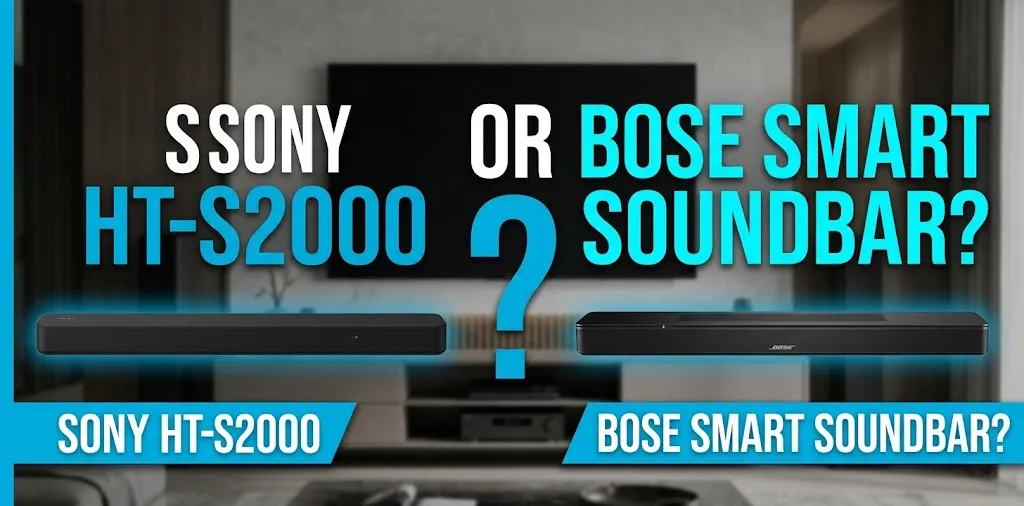
This is one of the biggest differences between these two models. The Sony HT-S2000 supports Dolby Atmos and DTS:X, but it creates its height effects through Sony’s Vertical Surround Engine rather than using physical upward-firing speakers. RTINGS found that the HT-S2000 has to downmix height and surround formats into stereo in its tested playback, which limits the sense of immersion compared with more advanced Atmos systems.
The Bose Smart Soundbar takes a different approach. It has upward-firing speakers and supports Dolby Atmos, allowing it to create actual height cues from compatible Atmos content. Bose also uses TrueSpace processing for non-Atmos material.
For a small room, this can work especially well because you don’t need a huge listening area for the sound to feel more spacious.
The Sony’s DTS:X support is still valuable if you have content that uses DTS formats, but Bose’s physical upward-firing design gives it the advantage for Atmos-focused movie watching.
Which one is easier to fit under a TV?
Bose wins on physical size.
The Smart Soundbar is about 27.34 inches wide and 2.21 inches tall. The Sony is 31.5 inches wide and about 2.63 inches tall.
That difference may not sound large, but it matters when you’re working with a small TV stand.
For example, imagine a small apartment with a 43-inch TV sitting on a narrow media console. Either soundbar can work, but the Bose leaves more room on the sides and has a lower profile.
If your TV stand is already crowded, Bose is the easier fit.
Connectivity and smart features
This is another clear win for Bose.
The Bose Smart Soundbar supports Wi-Fi, Bluetooth, Apple AirPlay 2, Spotify Connect, and Chromecast built-in. It also supports built-in voice control features.
Sony keeps things more focused. The HT-S2000 offers Bluetooth 5.2, HDMI eARC/ARC, optical input, and USB support. It also works with Sony’s Home Entertainment Connect app and integrates with compatible BRAVIA XR televisions.
This creates a simple choice.
If you want to stream music from your phone, use AirPlay or Chromecast, and connect the soundbar to a broader smart-home setup, Bose is much more flexible.
If your main plan is TV → HDMI eARC → soundbar, Sony gives you what you need without putting as much emphasis on connected features.
What about adding a subwoofer later?
Both soundbars can be expanded. Sony supports compatible wireless subwoofers and rear speakers, including the SA-SW3, SA-SW5, and SA-RS3S.
Bose also offers an optional Bass Module and additional surround options. Its newer Personal Surround feature can even use compatible Bose Ultra Open Earbuds as personal surround speakers.
For a small room, though, I would not buy the extra equipment immediately.
Start with the soundbar by itself. A small room can make bass feel stronger than it would in a large open living room, and adding a subwoofer too early can make the setup unnecessarily expensive or bass-heavy.
Sony HT-S2000 vs Bose Smart Soundbar: Which should you buy?
Choose the Sony HT-S2000 if your priorities are:
- Stronger built-in bass
- Clear dialogue from a dedicated center channel
- DTS:X and wider format support
- A simple TV-focused setup
- The option to add a Sony subwoofer and rear speakers later
- Good movie performance without buying a separate subwoofer immediately
Choose the Bose Smart Soundbar if your priorities are:
- The smallest physical footprint
- Dolby Atmos with upward-firing speakers
- Better smart streaming options
- AirPlay 2, Chromecast, and Spotify Connect
- Strong dialogue enhancement
- A compact bedroom or apartment setup
- A soundbar that can become part of a broader Bose system
There is also a price difference worth considering. Bose currently lists the Smart Soundbar at $549 on its US site, although its site also shows a current promotional price of $399. The Sony HT-S2000 originally launched around the $500 mark, but its current street price can vary considerably because it is an older model.
That means the better deal can change depending on the price you find.
Two small-room buying scenarios
You mostly watch Netflix and TV shows
Suppose you have a 43- or 50-inch TV in a bedroom or compact apartment living room. You mostly watch dramas, comedies, YouTube, and streaming shows, and you occasionally watch movies.
In that situation, Bose is the better fit. Its compact size, clear dialogue, Atmos support, and smart streaming features are more useful than having a lot of extra power you may not use.
You mostly watch action movies and listen to bass-heavy music
Now imagine a small living room where you watch Marvel movies, action films, sports, and bass-heavy music videos. You don’t want to buy a separate subwoofer right away.
Here, Sony makes more sense. The built-in dual subwoofer gives it an important advantage, and its support for DTS:X and other audio formats gives enthusiasts more flexibility.
The biggest weakness of each soundbar
The Sony’s biggest weakness is that its surround and height effects are simulated rather than produced by physical upward-firing speakers. It also lacks the deep low-bass performance you would get from a dedicated subwoofer.
The Bose’s biggest weakness is its lack of deep bass. Its compact design works well for a small room, but action-movie fans may eventually want the optional bass module. It also does not support DTS.
So neither one is a complete replacement for a full home theater system. That’s actually fine for this comparison. A small room often benefits more from a well-matched compact soundbar than from a large, expensive surround system.
Frequently Asked Questions
Before choosing between the Sony HT-S2000 and Bose Smart Soundbar, you may still have a few practical questions about small-room performance, bass, Dolby Atmos, and everyday TV use. Here are the answers to the most important questions buyers often consider before making a decision.
Is the Bose Smart Soundbar good for a small bedroom?
Yes. Its compact 27.34-inch width and 2.21-inch height make it easy to place under a TV, and Bose lists a suggested room size of 10 × 12 feet. Its clear dialogue and Atmos features also suit smaller viewing spaces well.
Does the Sony HT-S2000 have enough bass without a subwoofer?
Yes, for many small rooms. The HT-S2000 has a built-in dual subwoofer, so it can deliver more bass than a basic standalone soundbar, although independent testing still finds that it does not reproduce the deepest low-bass frequencies as strongly as a dedicated subwoofer.
Which is better for Dolby Atmos, Sony HT-S2000 or Bose Smart Soundbar?
The Bose Smart Soundbar has the advantage for Dolby Atmos because it uses upward-firing speakers along with Dolby Atmos processing. The Sony supports Dolby Atmos and DTS:X but relies on virtual height processing rather than physical upward-firing drivers.
Final verdict
The Bose Smart Soundbar is the better choice for most small rooms. Its smaller body, upward-firing Atmos speakers, clear dialogue processing, and strong wireless streaming support make it particularly well suited to bedrooms, apartments, and compact living rooms. Bose itself suggests a 10 × 12-foot room for this model, which closely matches the type of space this comparison is about.
But the Sony HT-S2000 is the better choice for buyers who value bass and movie-focused features more than smart connectivity. Its built-in dual subwoofer, 3.1-channel design, DTS:X support, and upgrade path make it a strong alternative.
If the two are close in price, I’d choose Bose for a small room and everyday TV use. If the Sony is substantially cheaper, or you care more about bass and DTS:X, the HT-S2000 can be the smarter buy.