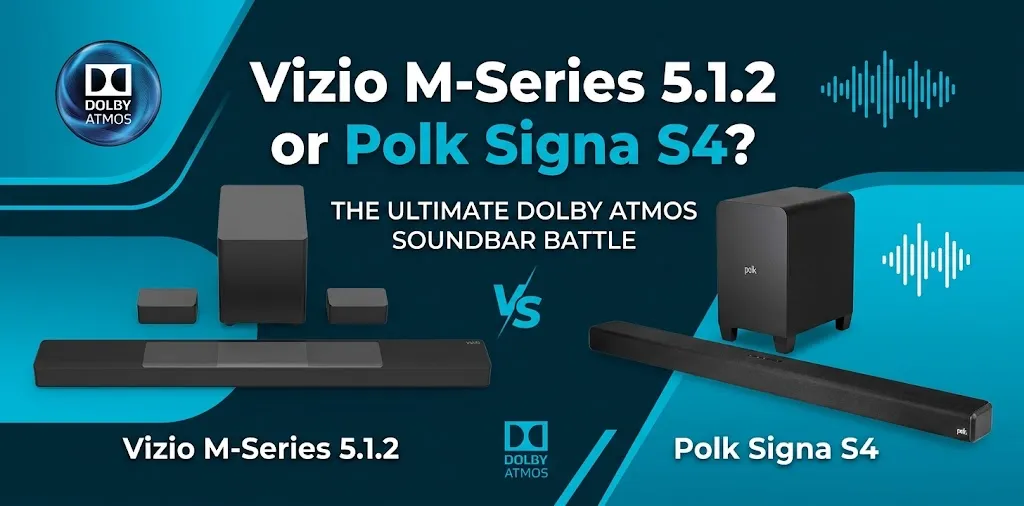
Vizio M-Series 5.1.2 or Polk Signa S4? Which has better surround sound?

If surround sound is your main priority, the Vizio M-Series 5.1.2 (M512a-H6) is the stronger choice over the Polk Signa S4. The Vizio has dedicated rear surround speakers plus two up-firing height channels, while the Polk uses a 3.1.2 layout with no separate rear speakers. That gives Vizio a more convincing front-to-back surround effect for movies and games.
The Polk Signa S4 is still a good option if you want a simpler setup with strong dialogue and Dolby Atmos effects. But if you are specifically asking which one creates a more complete surround experience, the Vizio has a clear advantage because it places actual speakers behind you.
Vizio M-Series 5.1.2 vs Polk Signa S4 at a glance
| Feature | Vizio M-Series 5.1.2 | Polk Signa S4 |
|---|---|---|
| Channel setup | 5.1.2 | 3.1.2 |
| Dedicated rear speakers | Yes | No |
| Up-firing speakers | Yes | Yes |
| Dolby Atmos | Yes | Yes |
| DTS | Yes | No |
| Wireless subwoofer | Yes | Yes |
| Dedicated center channel | Yes | Yes |
| Dialogue adjustment | Yes | Yes |
| Best for | True surround immersion | Simple Atmos setup |
| Surround performance | Better | Good, but limited |
| Available |  | |
The biggest difference is not simply the number in the product name. The Vizio’s 5.1.2 setup includes physical left and right rear channels, while the Polk Signa S4 is a 3.1.2 system with its surround and height effects created from the soundbar’s front-facing and up-firing speakers.
Why the Vizio M-Series 5.1.2 has better surround sound
The Vizio M512a-H6 is built more like a traditional home theater system. Its soundbar handles the front and center channels, the subwoofer handles low-frequency effects, and separate satellite speakers sit behind the listener.
That physical speaker placement makes a big difference.
When a movie sends a sound effect from the front of the room toward the rear, the Vizio can use its dedicated surround speakers to reproduce that movement behind you. This makes effects feel more connected to the room rather than simply spreading outward from the TV.
RTINGS found the Vizio’s satellite speakers help create an immersive movie experience, while Tom’s Guide also highlighted its separate surrounds as an important part of its 360-degree sound.
The Vizio also adds two up-firing speakers for Dolby Atmos and DTS height effects. Those speakers bounce sound toward the ceiling to create the impression of audio coming from above.
That gives the M-Series a useful combination: physical rear surround + simulated height effects.
How the Polk Signa S4 creates surround sound
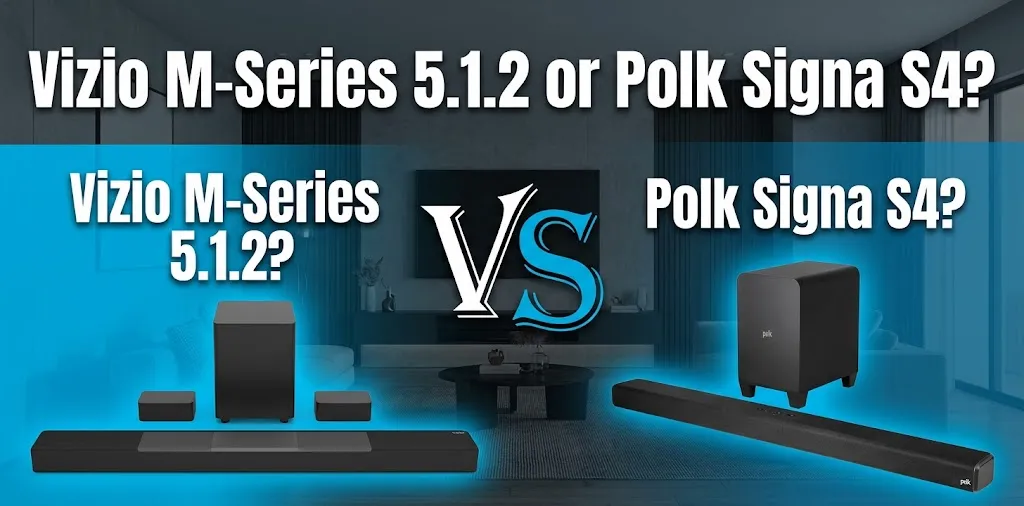
The Polk Signa S4 takes a different approach. It is a 3.1.2 system with left, center, right, and two up-firing height channels, plus a wireless subwoofer. It does not include separate rear speakers.
Polk uses processing and the soundbar’s speaker arrangement to create a wider surround presentation. This can work surprisingly well in the right room.
Digital Trends found the Signa S4 capable of producing convincing surround effects and a wide, deep soundstage, particularly with Dolby Atmos content.
The limitation becomes more obvious when you compare it directly with a system that has speakers physically positioned behind the listener. WIRED specifically noted that the Signa S4 is less immersive than systems with dedicated rear speakers.
So the Polk can make your room sound bigger, but it does not create the same physical sense of sound coming from behind you.
Dolby Atmos: Vizio vs Polk
Both soundbars support Dolby Atmos, but their Atmos experiences are not identical.
The Vizio M-Series has two up-firing speakers in the main soundbar. Its rear speakers then handle the surround channels separately. This means the system can create both rear effects and height effects using different physical speakers.
The Polk Signa S4 also has two up-firing speakers, and several reviews have praised its Atmos performance for its price. Digital Trends, for example, found its height effects surprisingly convincing in suitable content.
However, Atmos is not only about sounds coming from above. A good Atmos system also needs convincing movement around the listener. That is where the Vizio’s dedicated rear speakers give it an advantage.
RTINGS notes that the Vizio provides an immersive surround experience through its satellites, although its height performance is not as impressive as more expensive Atmos systems.
Your ceiling and room still matter
Neither system will create identical Atmos effects in every room.
Up-firing speakers depend on sound reflecting from the ceiling. A very unusual ceiling shape, a very high ceiling, or other room conditions can reduce the height effect.
This matters especially with the Vizio because you may assume the “5.1.2” label automatically means powerful overhead sound. It does not. The system’s rear surround effect is more dependable because those speakers are physically behind you, while the height effect depends more on room conditions.
Which one is better for movies?
Vizio M-Series 5.1.2 wins for movies.
Action movies benefit the most from the Vizio’s extra surround speakers. A helicopter, vehicle, flying object, or other moving effect can travel across the front and into the rear channels instead of remaining concentrated around the soundbar.
The subwoofer also adds weight to explosions, music, and other low-frequency effects. RTINGS found the Vizio’s subwoofer capable of adding rumble to action scenes, although its satellites can become less clean at high volumes.
The Polk is still enjoyable for movie watching. Its Atmos presentation can produce a wide soundstage, and its wireless subwoofer gives movies more impact than a basic soundbar without a subwoofer.
But if your goal is to feel surrounded by movie sound, the Vizio’s physical rear channels make the difference.
Which one is better for TV dialogue?
This category is much closer.
Both systems have a dedicated center channel, which helps keep voices centered on the screen. The Polk Signa S4 also has Polk’s VoiceAdjust feature, which lets you increase the prominence of dialogue. It also includes a Night mode that reduces bass while making voices easier to hear at lower listening levels.
The Vizio also provides center-channel adjustment, and reviewers generally found voices clear.
If you frequently watch dialogue-heavy shows, older TV programs, or content where voices are difficult to hear, the Polk’s voice adjustment controls make it particularly appealing.
Winner for dialogue: Polk Signa S4, by a small margin.
Which one is better for bass?
The Vizio generally has the stronger home-theater bass experience.
Its dedicated wireless subwoofer gives explosions and action scenes more physical impact. RTINGS describes the Vizio as capable of producing bass rumble that helps bring action movies and bass-heavy music to life.
The Polk also includes a wireless subwoofer, and reviewers have praised its ability to add useful low-end weight. But it does not deliver the same deep low-bass impact expected from a larger home-theater setup. RTINGS specifically points to the Signa S4’s lack of very deep low-bass as a weakness for action-heavy movies.
There is one catch with the Vizio: its bass can be too strong in some rooms. Tom’s Guide found that the subwoofer could become overpowering and recommended adjusting the levels to get a better balance.
Which system is easier to set up?
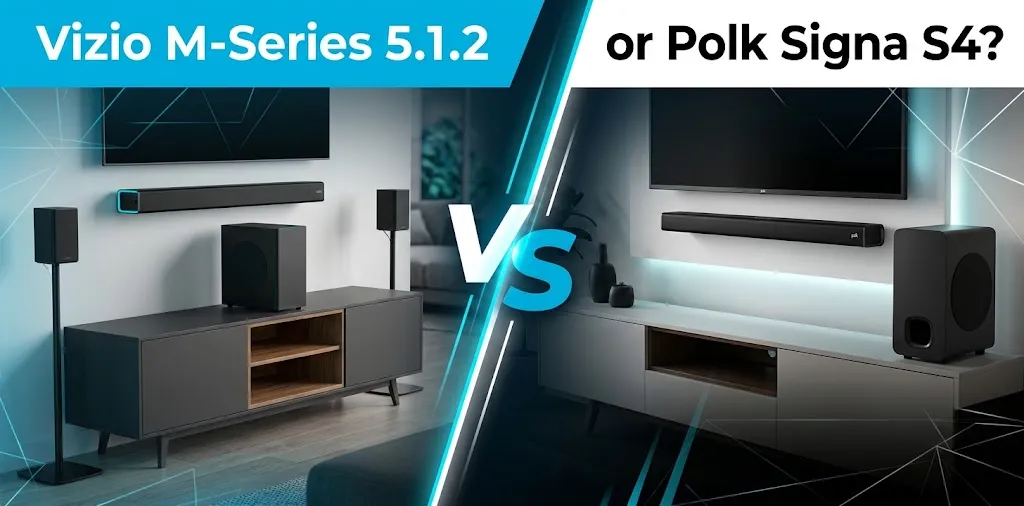
The Polk is essentially a soundbar-and-subwoofer package. You do not have to find locations behind your seating position for separate surround speakers.
That makes it a better fit for someone who wants an uncomplicated setup or has a living room where placing rear speakers is difficult.
The Vizio requires more planning. The rear speakers need to be positioned around your seating area, and Vizio’s satellite speakers connect to the subwoofer rather than operating as completely independent wireless speakers. That extra work is also what gives the Vizio its stronger surround performance.
What if you have a small living room?
The Polk Signa S4 can make more sense in a small or open room where rear speakers would be difficult to place.
Its 41.2-inch soundbar is paired with a wireless subwoofer, and the system does not require separate surround speakers behind the couch.
For example, imagine a small apartment where the couch is against the back wall. There may be no practical place for Vizio’s rear speakers. In that situation, the Polk’s simpler design can be more convenient even though its surround effect is not as complete.
On the other hand, if you have a normal living room with enough space beside or behind the seating area, the Vizio becomes much more attractive.
What if you mostly watch action movies and play games?
Choose the Vizio M-Series 5.1.2.
This is where dedicated rear speakers matter most. Games and action movies often contain directional sounds that move around the listener. Physical rear channels can make those effects easier to localize.
The Vizio also supports Dolby Atmos and DTS, giving compatible content additional height information.
The Polk can still produce an engaging presentation, but it relies more heavily on processing and front-mounted speakers to create the surround effect.
If you sit in the same position for gaming or movie watching and can properly place the rear speakers, the Vizio is the better fit.
Vizio M-Series 5.1.2 vs Polk Signa S4: main trade-offs
The choice becomes easier when you look at what each system gives up.
Choose the Vizio M-Series 5.1.2 if you want:
- Stronger physical surround sound
- Dedicated rear speakers
- Dolby Atmos height effects
- DTS support
- More convincing movie immersion
- Stronger low-frequency impact
- More control over individual channel levels
The Vizio gives you more of a traditional home-theater experience, but you need the room and patience to set it up properly.
Choose the Polk Signa S4 if you want:
- A simpler setup
- Good Dolby Atmos performance without rear speakers
- Clear dialogue
- VoiceAdjust controls
- A wide soundstage from a compact system
- Fewer speakers around the room
The Polk’s biggest advantage is convenience. You get an Atmos-capable soundbar and subwoofer without having to arrange separate rear speakers.
Which has better surround sound: Vizio M-Series 5.1.2 or Polk Signa S4?
The Vizio M-Series 5.1.2 has better surround sound.
The reason is simple: it uses dedicated rear speakers. The Polk Signa S4 can create a wide and convincing surround presentation, but it does not have physical speakers behind the listener. For movies and games with directional surround effects, the Vizio produces a more complete sense of sound coming from around the room.
The Polk’s up-firing speakers can produce impressive Atmos height effects, so it is not a weak performer. It is simply designed for people who want a simpler system.
Which one should you buy?
If surround sound is the deciding factor, get the Vizio M-Series 5.1.2 (M512a-H6).
Its combination of dedicated rear speakers, a subwoofer, and up-firing Atmos speakers gives it the more convincing home-theater layout. Reviews from RTINGS and Tom’s Guide both point to the benefit of its separate surround speakers for immersive movie playback.
The Polk Signa S4 is the better alternative when simplicity matters more than having sound physically behind you. It offers good Atmos performance, clear dialogue, and a useful subwoofer without requiring rear-speaker placement.
One practical tip: don’t judge either soundbar only by the channel number. Your room and speaker placement can have a major effect on the result. If you have enough space to place rear speakers correctly, the Vizio’s advantage becomes much easier to hear.
Frequently Asked Questions
Is the Vizio M-Series 5.1.2 better than the Polk Signa S4 for movies?
Yes. The Vizio is better for movies when surround immersion is the priority because it has dedicated rear speakers in addition to its Atmos height channels. The Polk still produces a wide and enjoyable presentation, but it cannot reproduce rear-channel effects in the same physical way.
Does the Polk Signa S4 have true rear surround speakers?
No. The Signa S4 is a 3.1.2 system with two up-firing height drivers, a center channel, left and right channels, and a subwoofer. It uses processing to create a wider surround presentation rather than using separate speakers positioned behind the listener.
Is Vizio 5.1.2 worth choosing over Polk Signa S4 for Dolby Atmos?
If you have room for the rear speakers, yes. The Vizio combines up-firing Atmos drivers with dedicated rear channels, giving compatible movies a more complete surround field, while the Polk focuses on creating Atmos effects from the soundbar itself.
Conclusion
The Vizio M-Series 5.1.2 is the better choice if your main goal is stronger surround sound. Its dedicated rear speakers create a more convincing sense of sound coming from around you, while the up-firing speakers add height effects for Dolby Atmos content.
The Polk Signa S4 makes more sense if you want a simpler setup with good dialogue and Atmos effects without placing speakers behind your seating area. But for movies, gaming, and overall surround immersion, Vizio M-Series 5.1.2 is the clear winner.