Polk Signa S2 or Hisense HS2100? Which is better for TV?

If you mainly want a simple upgrade from built-in TV speakers, both the Polk Signa S2 and Hisense HS2100 are solid 2.1 soundbars with wireless subwoofers. The Hisense HS2100 is the better overall choice for most TV viewers because it offers newer connectivity, more sound modes, DTS Virtual:X, and a balanced sound profile. The Polk Signa S2 is still a strong pick if clear dialogue and a slim soundbar are your priorities.
Polk Signa S2 vs Hisense HS2100 at a glance
Both models are designed to improve TV audio without the complexity of a full surround system. They use two main soundbar channels and a separate wireless subwoofer, so you get stronger bass than most TVs can produce on their own.
| Feature | Polk Signa S2 | Hisense HS2100 |
|---|---|---|
| Configuration | 2.1 | 2.1 |
| Wireless subwoofer | Yes | Yes |
| Subwoofer size | 5.25 inches | 5.25 inches |
| Max audio power | Not specified by Polk | 240W |
| HDMI connection | HDMI ARC | HDMI ARC/eARC, CEC |
| Optical | Yes | Yes |
| 3.5mm AUX | Yes | Yes |
| Bluetooth | Yes | Bluetooth 5.3 |
| USB | No | Yes |
| Virtual surround | Dolby Digital-based virtual surround | DTS Virtual:X |
| Sound modes | Movie, Music, Night | Movie, Music, News, Night, Sport, Game |
| Dialogue enhancement | VoiceAdjust | EQ and News mode |
| Roku TV Ready | No | Yes |
| Dolby Atmos | No | No |
| Soundbar height | 2.15 inches | 2.4 inches |
| Available |  | |
Polk lists HDMI ARC, optical, AUX, Bluetooth, a 5.25-inch wireless subwoofer, and a 45Hz–20kHz overall frequency response for the Signa S2. Hisense lists 240W maximum audio power, Bluetooth 5.3, six sound modes, USB, HDMI ARC, optical, AUX, and Roku TV Ready support for the HS2100.
Which one sounds better for TV?
For general TV watching, the Hisense HS2100 has a small overall advantage because its sound is relatively balanced and it handles dialogue well while still giving movies and shows some extra bass.
Independent testing found the HS2100 good for dialogue and TV shows. Its warm sound profile, balanced mids and highs, EQ controls, and Night mode make it easy to adjust for speech-heavy content.
The Polk Signa S2 also performs well with TV shows. Its midrange is reasonably balanced, and Polk’s VoiceAdjust feature is specifically designed to make voices easier to understand.
The difference is that Polk puts more emphasis on its dedicated dialogue feature, while the Hisense gives you more ways to change the overall sound.
For dialogue: Polk has a useful advantage
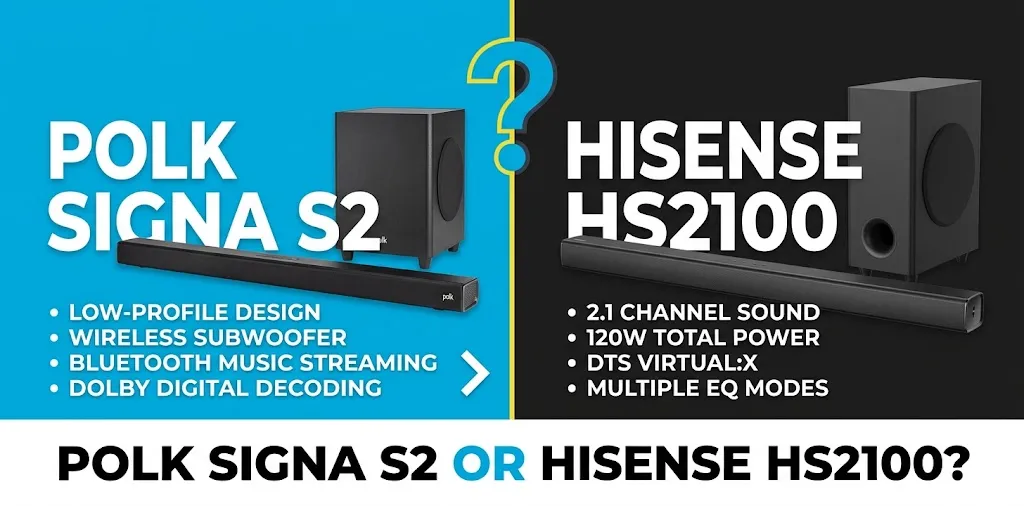
If your biggest complaint is that actors are difficult to understand, the Signa S2 deserves serious consideration.
Its VoiceAdjust technology lets you raise the vocal level without simply turning up the entire soundtrack. Polk also includes a Night Mode that reduces bass while helping dialogue remain clear at lower listening levels.
The HS2100 does not have a dedicated center speaker either, but it offers a News mode plus bass and treble adjustment. Testing also found its dialogue reproduction clear, although voices can be harder to pinpoint because there is no discrete center channel.
For movies: Hisense is the better choice
The Hisense HS2100 has an important advantage for movie sound: DTS Virtual:X. It can also handle Dolby Digital and DTS content through HDMI ARC.
The Polk Signa S2 supports Dolby Digital decoding and Polk’s virtual surround processing, but it does not support DTS or Dolby Atmos. Independent testing found that its 2.1 setup downmixes surround content to stereo, which limits immersion.
The HS2100 also downmixes surround content because it is still a 2.1 system, so don’t expect true rear-channel surround sound from either product.
Which has better bass?
Both soundbars include a separate 5.25-inch wireless subwoofer, so both can add much more impact to TV shows and movies than typical built-in TV speakers.
The Polk Signa S2 has a lively sound with noticeable bass and treble emphasis. Independent testing describes its sound as V-shaped, meaning the low and high frequencies receive more emphasis than the middle range. That can make action scenes and music sound energetic, although the bass can become somewhat boomy with certain content.
The HS2100 has a warmer sound with solid bass from its dedicated subwoofer. Its subwoofer is rated at 120W, while the complete system is rated at 240W maximum audio power.
Neither soundbar produces the kind of deep, powerful low-end you would expect from a larger home theater subwoofer. Independent testing also found limited low-frequency extension from the HS2100 despite its dedicated subwoofer.
Winner for bass: Hisense HS2100, by a small margin for overall balance; Polk may appeal more if you like a punchier sound.
Which has better features and connectivity?
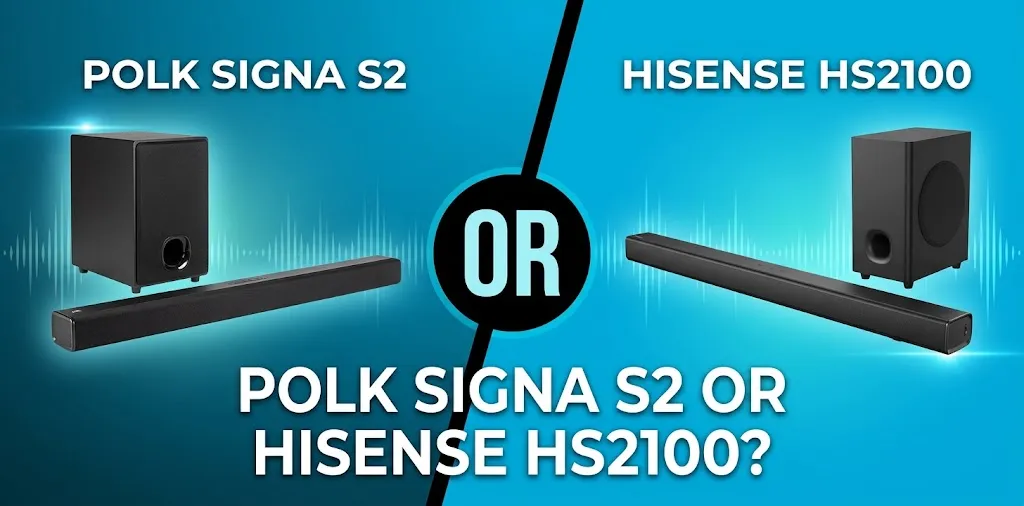
This is one of the clearest wins for the Hisense. The HS2100 includes Bluetooth 5.3, USB, optical, AUX, HDMI ARC, CEC, six sound modes, auto power-on, and Roku TV Ready support. Hisense also says compatible Roku TVs can control the soundbar through the Roku TV remote.
The Polk Signa S2 keeps things simpler. It includes HDMI ARC, optical, 3.5mm AUX, and Bluetooth. Its HDMI connection can also let a compatible TV remote control the soundbar’s volume through CEC.
For someone who simply wants to connect a soundbar and watch TV, Polk’s simpler setup is perfectly reasonable. But if you want more control and newer wireless connectivity, the Hisense is more flexible.
Which is easier to place under a TV?
The Polk Signa S2 is slightly slimmer. Its soundbar is 35.43 inches wide and only 2.15 inches tall. Polk specifically designed it to fit in front of a TV without blocking the bottom of the screen or remote sensor.
The Hisense HS2100 measures 31.5 inches wide, 2.4 inches high, and 3.5 inches deep. Its smaller width can be useful with a compact TV stand, although it is a little taller than the Polk.
The subwoofer also needs its own floor or shelf space. The Hisense subwoofer measures 4.3 × 11.8 × 13.8 inches, while Polk’s is about 6.72 × 13.4 × 12.2 inches.
Winner for a very low TV stand: Polk Signa S2
Winner for a narrower TV setup: Hisense HS2100
What about everyday TV watching?
This is where both soundbars make sense.
Imagine you have a 55-inch TV in a normal living room and mostly watch Netflix, YouTube, news, sports, and regular cable or streaming shows. Either soundbar will give you fuller sound and stronger bass than the TV’s built-in speakers.
If you often watch dialogue-heavy shows late at night, the Polk’s VoiceAdjust and Night Mode are useful. If you watch a mix of movies, sports, games, news, and music, the Hisense gives you more sound modes and a wider range of adjustment options.
For a second example, consider a smaller bedroom TV. In that situation, you may not need maximum output or advanced surround effects. The Polk’s low-profile design could be more important than the Hisense’s extra features.
Which one should you buy?
The answer depends on what you expect from your TV audio.
| If you care most about… | Better choice |
|---|---|
| Overall TV experience | Hisense HS2100 |
| Clear dialogue | Polk Signa S2 |
| Movie features | Hisense HS2100 |
| More sound modes | Hisense HS2100 |
| Newer Bluetooth | Hisense HS2100 |
| Roku TV integration | Hisense HS2100 |
| Very slim soundbar | Polk Signa S2 |
| Simple TV setup | Polk Signa S2 |
| Strong bass with a lively sound | Polk Signa S2 |
| More flexible sound adjustment | Hisense HS2100 |
The biggest thing to remember is that neither product is a true surround-sound system. Both are 2.1-channel designs, so a separate pair of rear speakers would be needed for a more convincing surround setup.
Is the Hisense HS2100 worth choosing over the Polk Signa S2?
For most people shopping specifically for a TV soundbar, yes. The HS2100 is the newer design and brings useful features such as Bluetooth 5.3, DTS Virtual:X, six sound modes, USB playback, auto power-on, and Roku TV Ready support.
Its sound is also well suited to everyday TV watching. Independent testing found it good for dialogue and TV shows, with balanced mids and highs and useful EQ controls.
The Polk Signa S2 is still worth considering if you find it at a clearly lower price or if dialogue clarity and its very low-profile design matter more to you.
Are there any reasons to choose the Polk Signa S2?
Yes. The Signa S2 is not simply an outdated alternative.
Its main strengths are its slim 2.15-inch soundbar, dedicated VoiceAdjust dialogue technology, wireless subwoofer, and straightforward connection options. Polk also includes both HDMI and optical cables, which makes setup easy with many TVs.
It can also get loud enough for most everyday living-room use, although independent testing found some compression and distortion when pushed hard.
So if you mostly watch sitcoms, news, sports, and other dialogue-heavy content, the Polk remains a sensible choice.
Which soundbar is better for a Hisense or Roku TV?
The HS2100 has the clearest advantage if you own a compatible Roku TV because Hisense identifies it as a Roku TV Ready soundbar. That allows the Roku TV and soundbar to work together through the HDMI connection and lets you use the Roku TV remote for soundbar control.
For other TV brands, the choice is less about brand matching and more about the features you want.
If your TV has HDMI ARC or eARC, that is generally the connection to try first. It keeps TV audio and volume control simple. If HDMI ARC is unavailable or gives you problems, both models also provide optical connectivity.
Does either soundbar support Dolby Atmos?
No. Neither the Polk Signa S2 nor the Hisense HS2100 supports Dolby Atmos.
That matters if you specifically want height effects from Atmos movies and shows. The Hisense does offer DTS Virtual:X, which attempts to create a wider, more immersive presentation from its 2.1 speaker layout, but it is not the same as having dedicated height or rear speakers.
The Polk Signa S2 also uses virtual surround processing, but independent testing found its surround performance limited by the 2.1 design.
Frequently Asked Questions
Still not sure whether the Polk Signa S2 or Hisense HS2100 is right for your TV? Here are some common questions to help you make the right choice. We’ll quickly compare their dialogue, features, movie performance, and overall value.
Is the Polk Signa S2 or Hisense HS2100 better for dialogue?
The Polk Signa S2 has an advantage if dialogue is your main concern because its VoiceAdjust feature is designed specifically to make speech easier to hear. The Hisense HS2100 is also good for dialogue and adds a News mode plus EQ controls for adjusting the sound.
Which has better features, the Polk Signa S2 or Hisense HS2100?
The Hisense HS2100 has the stronger feature set, with Bluetooth 5.3, six sound modes, DTS Virtual:X, USB, auto power-on, and Roku TV Ready support. The Polk Signa S2 focuses on simpler connectivity, dialogue enhancement, and easy TV use.
Is the Hisense HS2100 better for movies than the Polk Signa S2?
Yes, the HS2100 is the better choice for movies between these two because it supports DTS as well as Dolby Digital and includes DTS Virtual:X. Neither soundbar supports Dolby Atmos, though, and both remain limited by their 2.1-channel design.
Final Verdict
The Hisense HS2100 is the better overall choice for TV.
It offers a more modern feature set, useful sound modes, DTS Virtual:X, Bluetooth 5.3, Roku TV Ready support, and a balanced sound that works well for everyday TV shows. Independent testing also rates it well for dialogue and TV content.
The Polk Signa S2 is the better specialized choice for dialogue and low-profile placement. Its VoiceAdjust technology is useful when voices are hard to hear, and its 2.15-inch height makes it easy to fit beneath many TVs.
If both are close in price, I’d choose the Hisense HS2100. If the Polk Signa S2 is substantially cheaper and your main goal is clearer TV dialogue rather than movie immersion, the Polk can still be the smarter buy.